
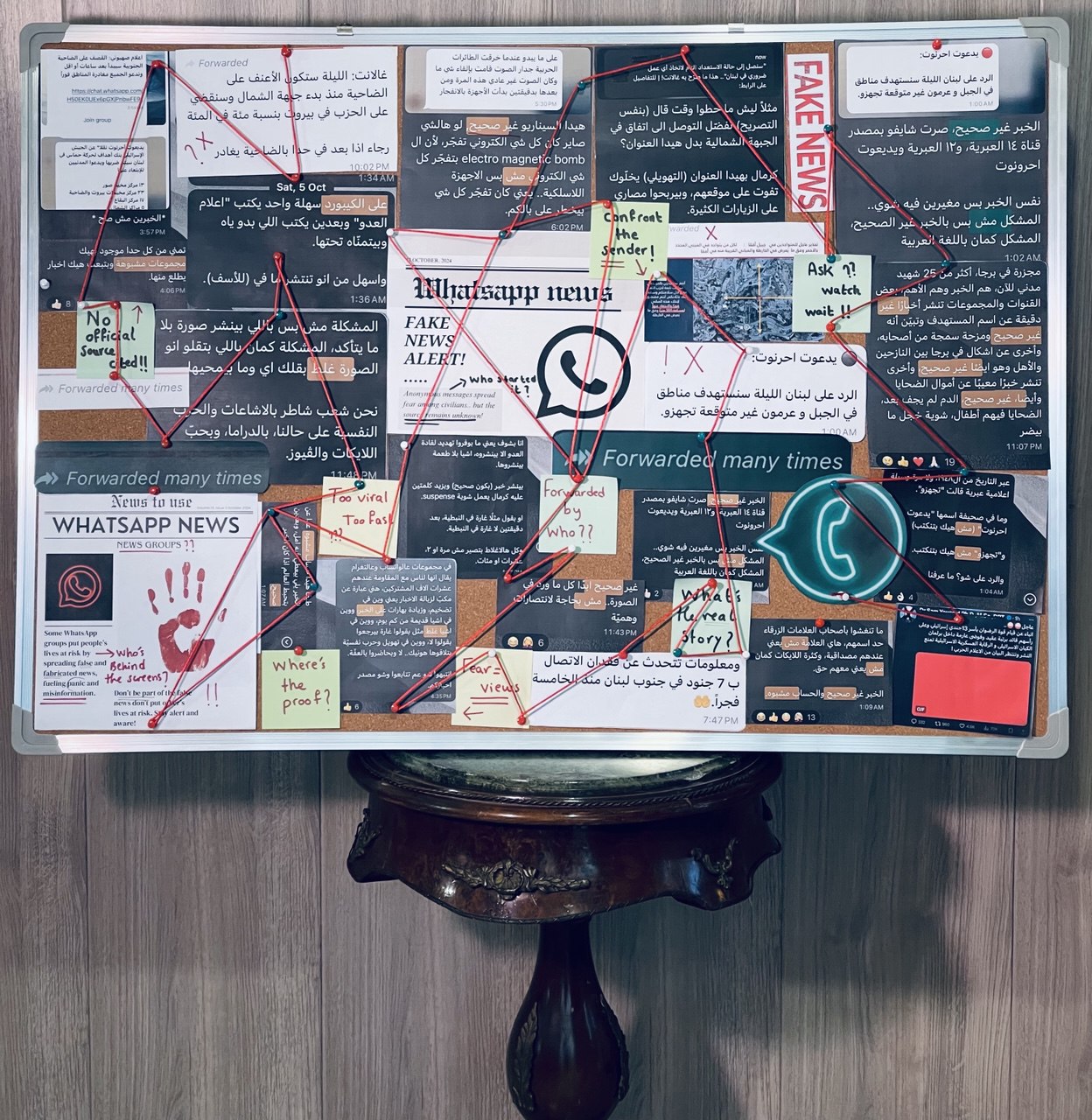
Some consider journalism to be a dry profession — nothing more than writing reports. And while report writing in itself is a noble and important task, journalism goes much deeper than that.
Behind every published report lies a long process and tremendous effort.
Journalism means long hours of verification, scrutiny, and the search for truth.
From this understanding came the idea of this investigative board — to make it clear that gathering information and evidence in journalism is neither random nor illusory, but rather a real, tangible effort that requires time, focus, investigation, and persistence.
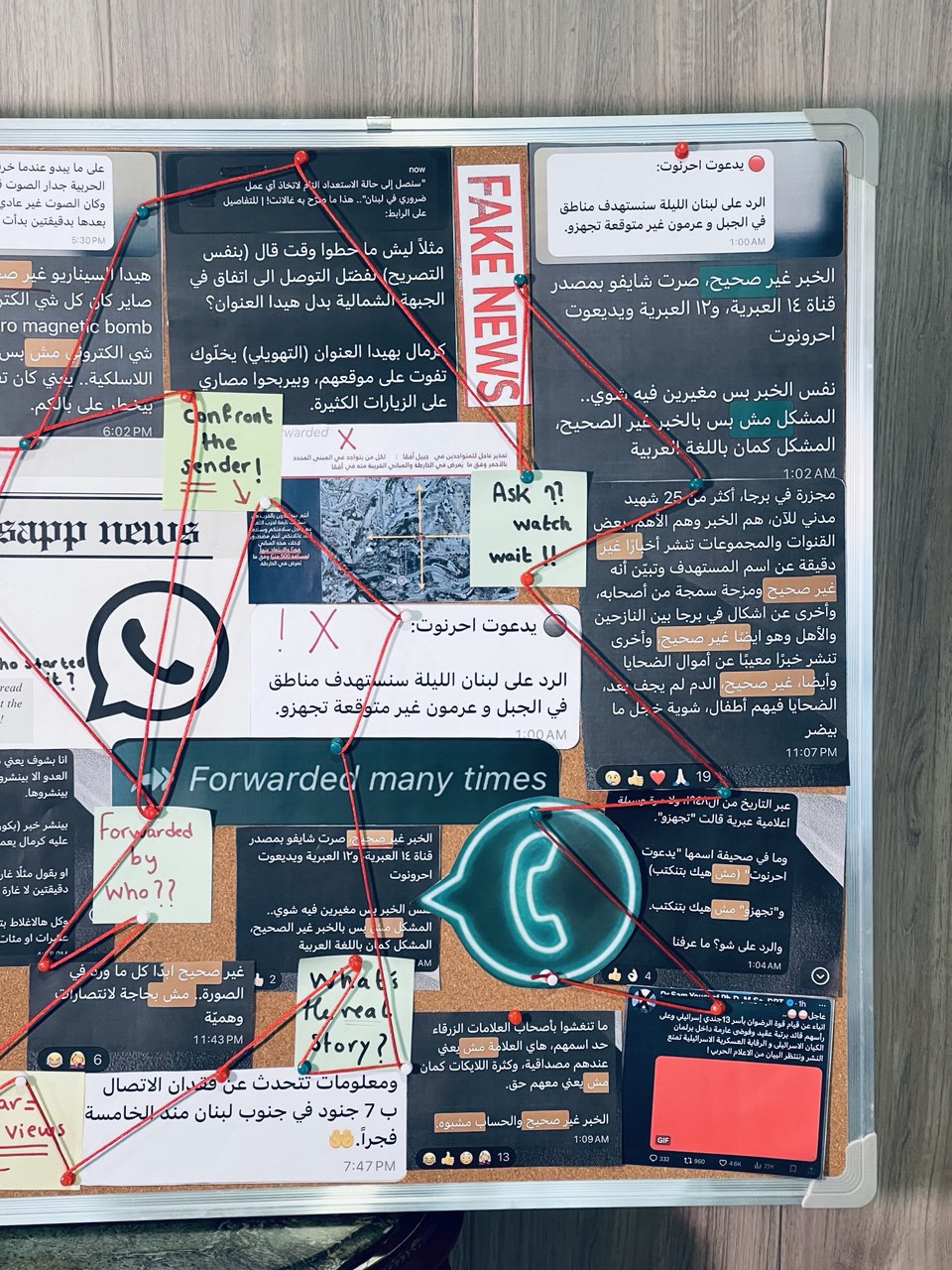
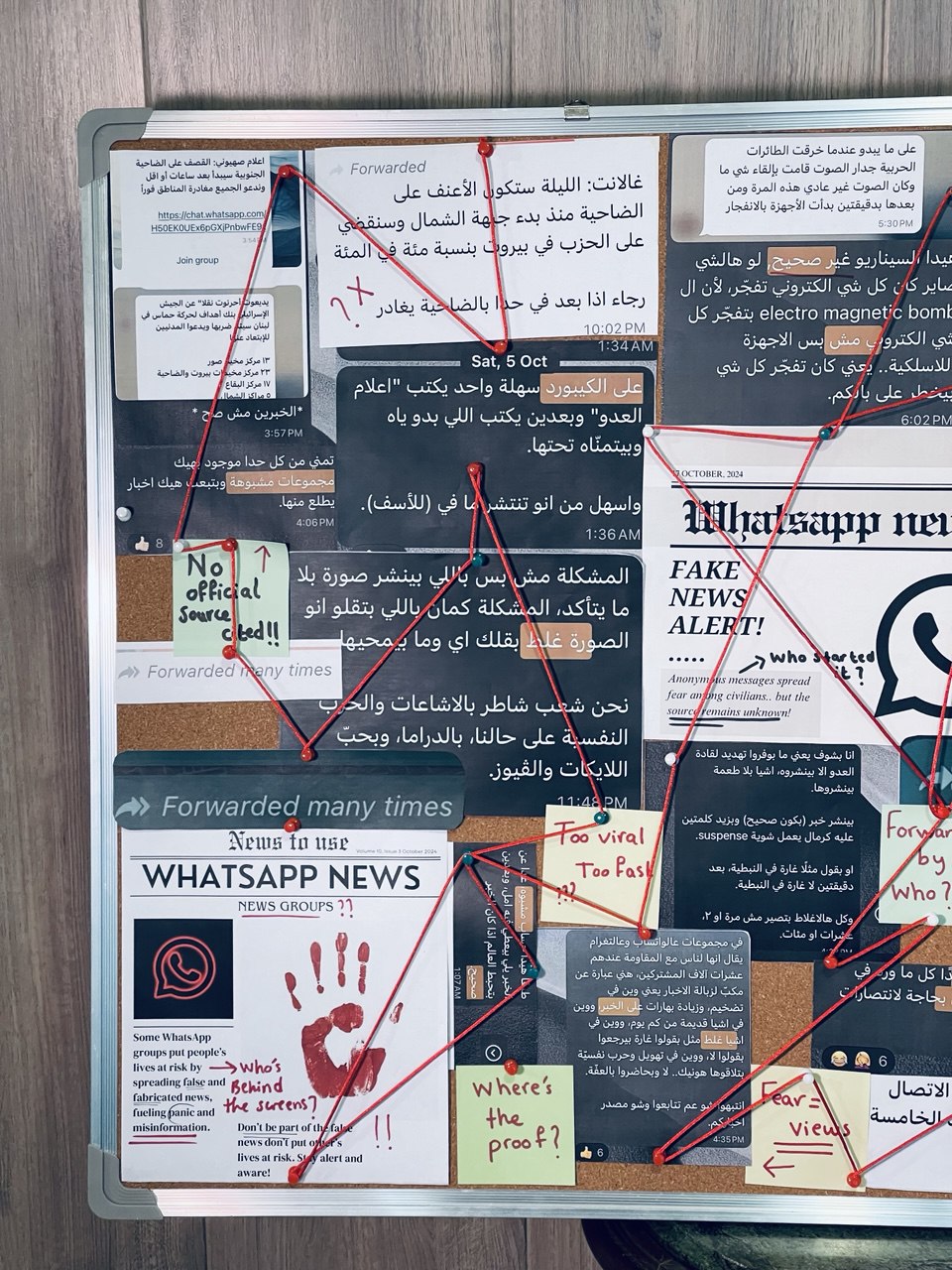
Red threads connect the pieces of evidence, false news circulated in WhatsApp groups placed side by side with verified facts —in a visual comparison that reveals the depth of deception.
Numerous images were carefully collected to serve as arguments and proof, used to raise awareness and promote critical thinking.
This board is not just an idea that was executed —it sits at the very core of the investigation, a living part of the ongoing journey to uncover evidence.
Because investigative journalism is not a one-hour search, nor a day, nor even a week.
It is a path that stretches across days and months,where truths are unearthed and threads are followed — until the truth is finally able to breathe freely.
The investigation begins with observation —
closely watching every detail in the world of news circulation on social media.
Then comes the collection of lies and misinformation,
linking them to the facts, and marking them with question marks and exclamation points.
The red thread is woven between the pieces of evidence —
like strands telling the story of deception and the struggle between truth and illusion.
Here, on this investigative board, the zero hour emerges — the moment to decode false news.
Investigation is a tireless effort that draws the line between misguidance and awareness.
It invites the reader to think critically,to question everything before believing it or sharing it.
Before the Investigative Board
The Investigative Board Phase
Beyond the Form: How It Was Deeply Made
Time
Building the board took days of preparation, including printing, cutting, mounting, and experimenting with multiple layouts until it reached its final form.
Research
Every screenshot has a story—each with a source, a motive, and a path of circulation.
Collection
Archiving the messages and analyzing their content.
Sorting
Classifying the messages as rumors, misleading news, or distorted facts.
Mapping and Analysis
Using red string to connect messages to their sources or to the impact they created.
Visual Touches
Choosing colors, placements, and annotations so the board would be visually clear and charged with meaning